A clutch rarely fails overnight. Usually it gives signals for weeks or even months, and they are easy to put down to cold weather or tiredness. In this article we’ve gathered the signs that the clutch is worn, a simple test you can do yourself, and what the replacement price is made up of.
How a clutch wears out
A manual gearbox clutch has three main parts: the friction disc, the pressure plate and the release bearing. Every time you pull away or change gear, the disc slips a little and the linings wear. In town, in traffic jams and on hills this happens far more often than on the motorway, so the same clutch can last very differently in two identical cars.
Many diesels and more powerful petrol cars also have a dual-mass flywheel. It damps engine vibration and wears alongside the clutch, so it’s checked at the same time.
7 signs of a worn clutch
- Revs rise, speed doesn’t. You press the accelerator in a high gear, the rev counter climbs, but the car accelerates sluggishly. This is the classic sign of a slipping clutch.
- The bite point keeps getting higher. If the car only starts moving when the pedal is almost fully up, the linings are thin.
- Burning smell. After a hill climb or a traffic jam there’s a distinctive smell in the cabin because the disc overheats from slipping.
- Hard to select a gear. Especially first and reverse, if the clutch doesn’t fully disengage.
- Noise at the pedal. Humming or squealing that changes as you press or release the pedal often comes from the release bearing.
- Judder when pulling away. Vibration as you set off can point to a worn disc or dual-mass flywheel.
- The pedal feels different. Stiff, soft, sinking or slow to return. Then the fault may be in the hydraulics, not the clutch itself.
How to check whether the clutch is slipping
Only do this test on an empty, level stretch of road where it is safe.
- Drive at about 50 km/h in third or fourth gear.
- Press the accelerator firmly to the floor.
- Watch the rev counter and the speedometer. If the revs jump but the car accelerates much more slowly, the clutch is slipping.
Don’t repeat the test several times in a row, because a slipping disc overheats quickly. How the signs change over time also matters: if a month ago the car still pulled at full throttle and now it slips, the wear is progressing fast.
An example: how it usually looks
Say you have a diesel estate with 230,000 km that you use in town and sometimes for towing a trailer. First you notice that the revs flare for a moment when you climb a hill with a full boot. A few weeks later it happens on the motorway when overtaking, and after a long traffic jam there’s a burning smell in the cabin.
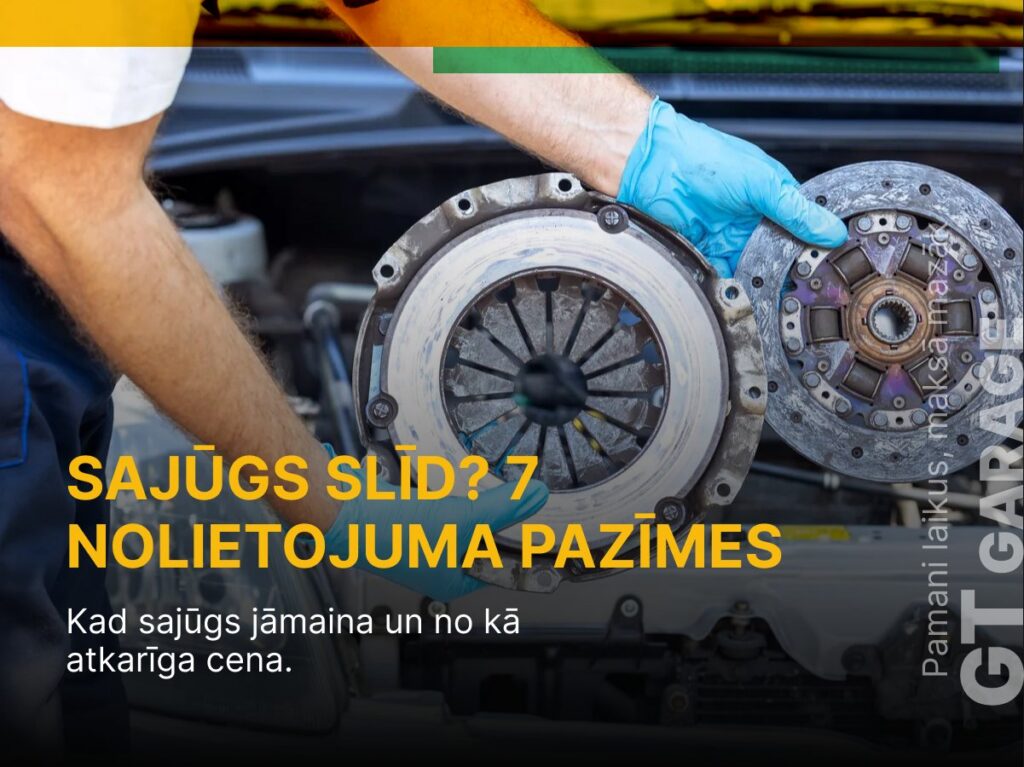
In a situation like this, the workshop first checks the pedal and the hydraulics, because they can cause similar symptoms. If the clutch is to blame, the gearbox comes off and the whole assembly is visible: the disc linings, the pressure plate surface, the release bearing and the flywheel. If the dual-mass flywheel turns out to be worn as well, it’s worth replacing it straight away so you don’t pay for removing the gearbox again a year later.
What clutch replacement costs and what it depends on
There is no single price for all cars. If someone quotes one over the phone without knowing your car, ask what’s included. The price is made up of:
- The clutch kit: disc, pressure plate and release bearing. The price depends on the car, the engine and the parts brand.
- Dual-mass flywheel: if it needs replacing, it often costs more than the clutch kit itself.
- Labour: most of the time goes into removing and refitting the gearbox. All-wheel-drive cars and models with a tight engine bay take longer.
- Extra parts: the hydraulic cylinder, gearbox seals or oil, if they are worn.
At GT Garage, clutch work starts with diagnostics from €40. Afterwards the mechanic calls you, explains what was found and agrees the price. Only then do we start, and the work and parts come with a warranty.
How to make the clutch last longer
- Don’t rest your foot on the clutch pedal while driving.
- At traffic lights, select neutral and release the pedal.
- On a hill, hold the car with the brake or hill-start assist, not the clutch.
- Pull away at low revs and change gear without needless slipping.
- When towing, don’t hold the engine at high revs with the clutch half engaged.
Frequently asked questions
Can I drive with a slipping clutch?
For a short while, yes, but it isn’t worth it. A slipping disc overheats and wears ever faster, it can damage the pressure plate and flywheel, and the car may fail to accelerate when you are overtaking.
How long does a clutch last?
The often quoted range is 100,000-200,000 km, but there is no single figure. In town, with a trailer or with sporty driving the clutch wears much faster than on the motorway.
Should the flywheel be replaced together with the clutch?
Not always. If the flywheel is in good condition, it stays. If it’s worn, it’s better to replace it together with the clutch, because both are reached by removing the gearbox.
How long does a clutch replacement take?
It depends on the car’s design and on parts availability. The mechanic will tell you the exact time after diagnostics.
Noticed one of the signs? Book a clutch check at GT Garage in Teika, Krustabaznīcas iela 12C, or call +371 23 777 337.